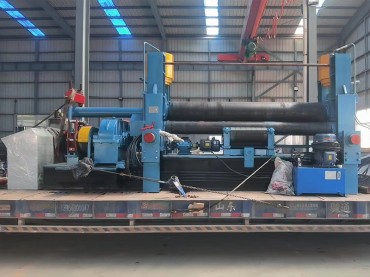
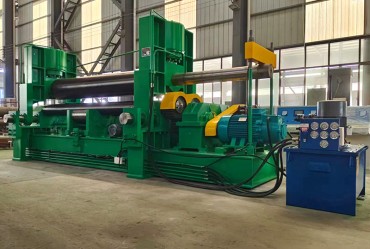
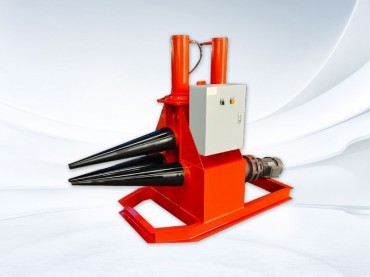
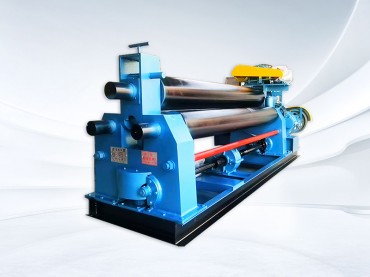
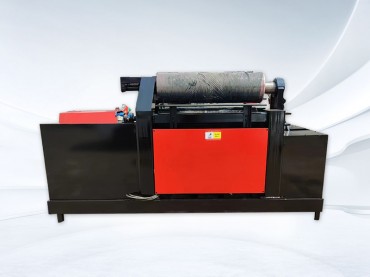
Shipbuilding is a massive and complex system engineering that involves numerous processes and equipment,with each link closely interconnected,collectively determining the quality,performance,and construction efficiency of ships.As one of the key equipment in shipbuilding,the rolling machine plays an irreplaceable core role in the process of forming ship structures.With its unique processing capability,it transforms flat materials into curved components that meet the requirements of ship curvature,laying a solid foundation for the smooth construction of ships.
The shape of a ship's hull is complex and diverse,requiring curved components to construct from smooth bow curves to rounded stern contours,and even different parts of the hull side curves.The rolling machine can bend metal sheets through its unique rolling process.Operators can adjust the roller spacing,pressure,and rotation speed of the plate rolling machine according to the curvature radius and shape parameters specified in the design drawings,so that the flat material gradually bends into the desired curved shape under the action of the rollers.For example,when constructing large oil tankers,their huge cargo oil bulkheads require specific curved shapes to ensure the strength and stability of the structure.The plate rolling machine can accurately roll thick steel plates into curved surfaces that meet design requirements,ensuring that the cargo oil bulkheads can be installed and providing security for the safe operation of the tanker.
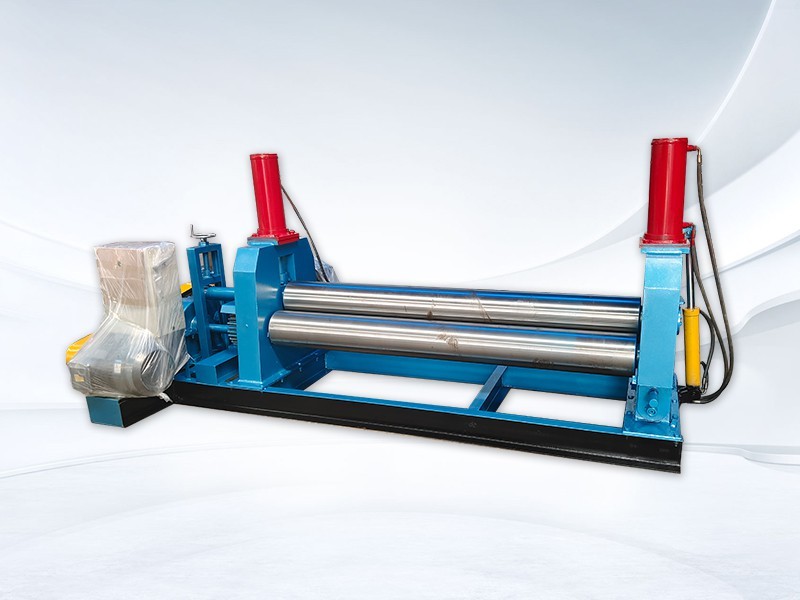
Shipbuilding requires high precision,and any dimensional deviation of a component may affect the assembly quality and performance of the entire hull.The rolling machine has high-precision processing capability,which can ensure the accurate size and smooth surface of the curved parts rolled.During the rolling process,advanced rolling machines are equipped with control systems and sensors that can monitor and adjust rolling parameters in real time,ensuring that the bending angle and curvature of the sheet are uniform and consistent.At the same time,the rollers of the rolling machine are carefully designed and processed,with a smooth surface and high hardness,which can reduce damage to the surface of the sheet and ensure the surface quality of curved parts.High quality curved components not only facilitate subsequent assembly work,but also improve the sealing and corrosion resistance of the ship,extending the service life of the vessel.
In shipbuilding,a large number of curved components are required,such as hull plates,rib plates,etc.The effective processing capability of the plate rolling machine enables these components to be produced in batches and quickly.Through reasonable process arrangement and equipment debugging,the rolling machine can continuously roll multiple curved parts of the same specifications in a short period of time,greatly shortening the production cycle.For example,when building a large container ship,hundreds of different specifications of hull plates are required,and the plate rolling machine can roll them in an orderly manner according to the production plan to meet the schedule requirements of ship construction.In addition,some modern rolling machines also have automated loading and unloading functions,further improving production efficiency and reducing manual operation time and labor intensity.
Shipbuilding is a multi process collaborative operation,and the application of plate rolling machines can make the various processes more closely connected.In the process of ship construction,the curved parts rolled by the plate rolling machine can directly enter the next process,such as assembly,welding,etc.Due to the ability of the bending machine to ensure the accuracy and quality of curved parts,it reduces the need for subsequent process corrections and adjustments,and improves the smoothness of the entire production process.For example,in the construction of ship sections,the ship plates rolled by the rolling machine can be quickly assembled with other components to form complete ship sections,and then transported to the final assembly site for final assembly through lifting equipment,greatly shortening the construction cycle of the ship.
During the rolling process,the rolling machine will cause certain plastic deformation to the metal sheet,which can optimize the mechanical properties of the material.By using a reasonable rolling process,the grain structure inside the board can be refined,improving the strength and toughness of the material.At the same time,the residual stress generated during the rolling process can to some extent offset the external forces acting on the ship during use,enhancing the stability of the hull structure.For example,when rolling high-strength steel,appropriate processing by a plate rolling machine can fully utilize the strength of the steel and improve its fatigue resistance,enabling ships to operate safely in harsh sea conditions.
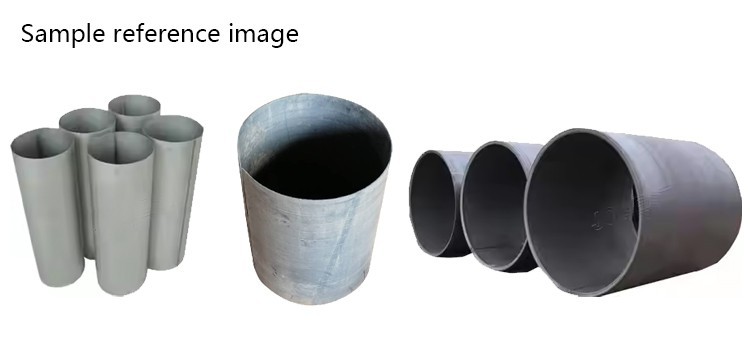
The rolling machine plays a core role in ship manufacturing.It can not only shape the curved parts of the hull to meet the complex shape requirements of the hull,but also improve the efficiency of ship construction,enhance the structural strength of the hull,and adapt to the construction needs of different types of ships.With the continuous development and technological advancement of the shipbuilding industry,the bending machine is also constantly innovating and upgrading,and its performance and processing capabilities will continue to improve.In the future,the bending machine will continue to play an important role in the field of shipbuilding,providing strong support for building more advanced and safe ships,and promoting the shipbuilding industry to move towards a higher level.


 Address:Room 1202, Detaitang Building, No. 118 Huaguang Road, Zhangdian District, Zibo, Shandong
 WhatsApp:+8615653328535
 Wechat: +8615965331535
  E-mail:zs@sdsmachinery.com